
Circular Economies Residency: Linda Tegg in Carnarvon #5
Linda Tegg is currently working with the community of Gwoonwardu/Carnarvon, hosted by Shire of Carnarvon. This residency is part of SPACED’s regional residency program, SPACED 5: Circular Economies.
Tegg is exploring the presence of communication satellites in the night sky. She recently hosted an open studio which invited locals to connect with her project, Situational Awareness, by activating the OTC Satellite Earth Station in Carnarvon.
Bringing awareness to intangible cultural resources, and challenging dominant narratives in space exploration, the project considers how this satellite system can connect communities to the world, yet also threaten vital Yingarrda cultural stories of astronomy with light pollution. Situational Awareness proposes a grounded alternative, imagining new narratives rooted in place, culture and interconnection.
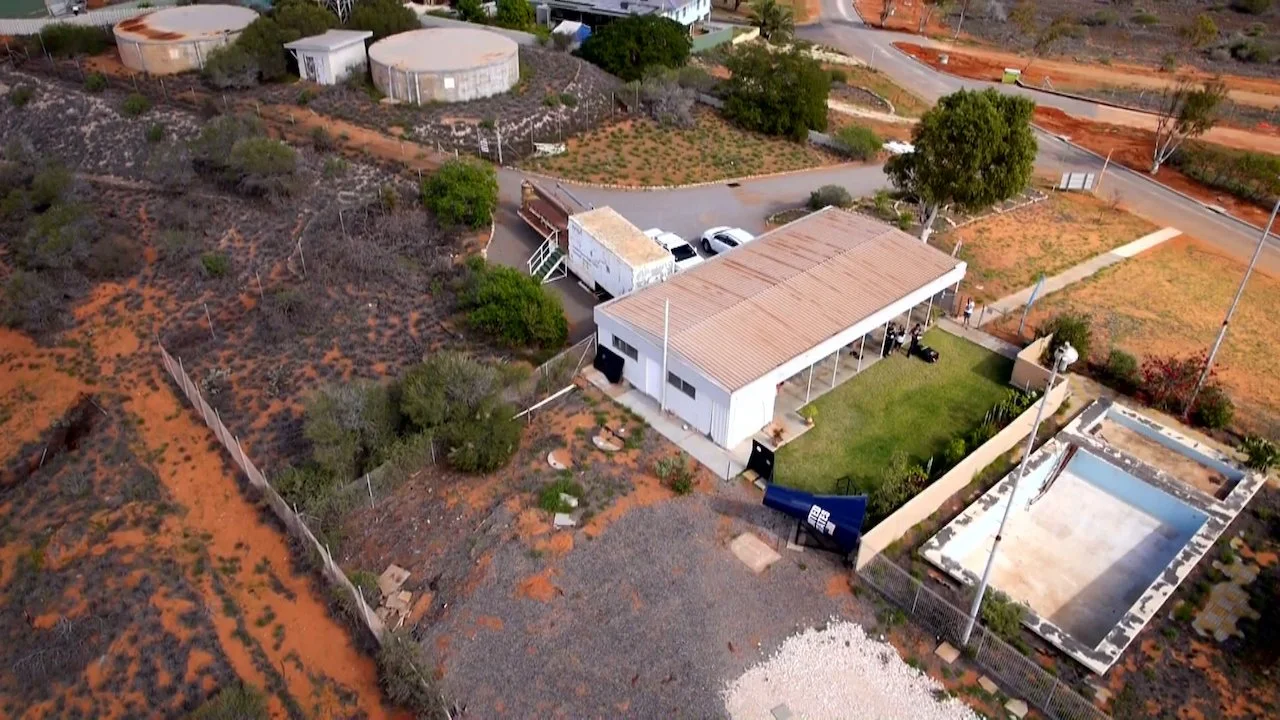
Coming to terms with the disappearance of the old pool at the OTC, I visit the Space and Technology Museum with Elizabeth and Miranda. I’m planning to host an open studio projecting the rushes from Bush Bay onto the outbuildings and possibly the enormous radio antennae. Elizabeth sees how it can be done and arranges to send up a projector.
…
I think about the pool as I approach the aquarium at Quobba point, the uniformity of the chlorinated water and tiles compared to the abundance of life beneath the surface here. Right off the beach you’re gliding over coral and the neon fish swimming amongst it, too many species to count. This occurs to me again as we snorkel in the river feeding the little lagoon at Francois Peron National Park, as we jump off the boat at the Coral Bay Marine Sanctuary and scramble into the magnificent gorges and pools of Karijini National Park.
…
The first place we visit is called Hancock gorge and it takes me a while to realise that it must be named in honour of the late mining magnate. Despite larger than usual rainfall this year the water in the pools of the National Park is noticeably lower than previous years. Experts attribute this to nearby mining activity beneath the water table.
We pass signs to Nameless Valley and Mount Nameless on the way to Karrijini. At the visitor’s centre we learn its traditional name, Jarndunmunha. A government website tells me that it was given the joint name Mt Nameless/Jarndunmunha in 2007, however the road signage sticks with Mt Nameless alone.
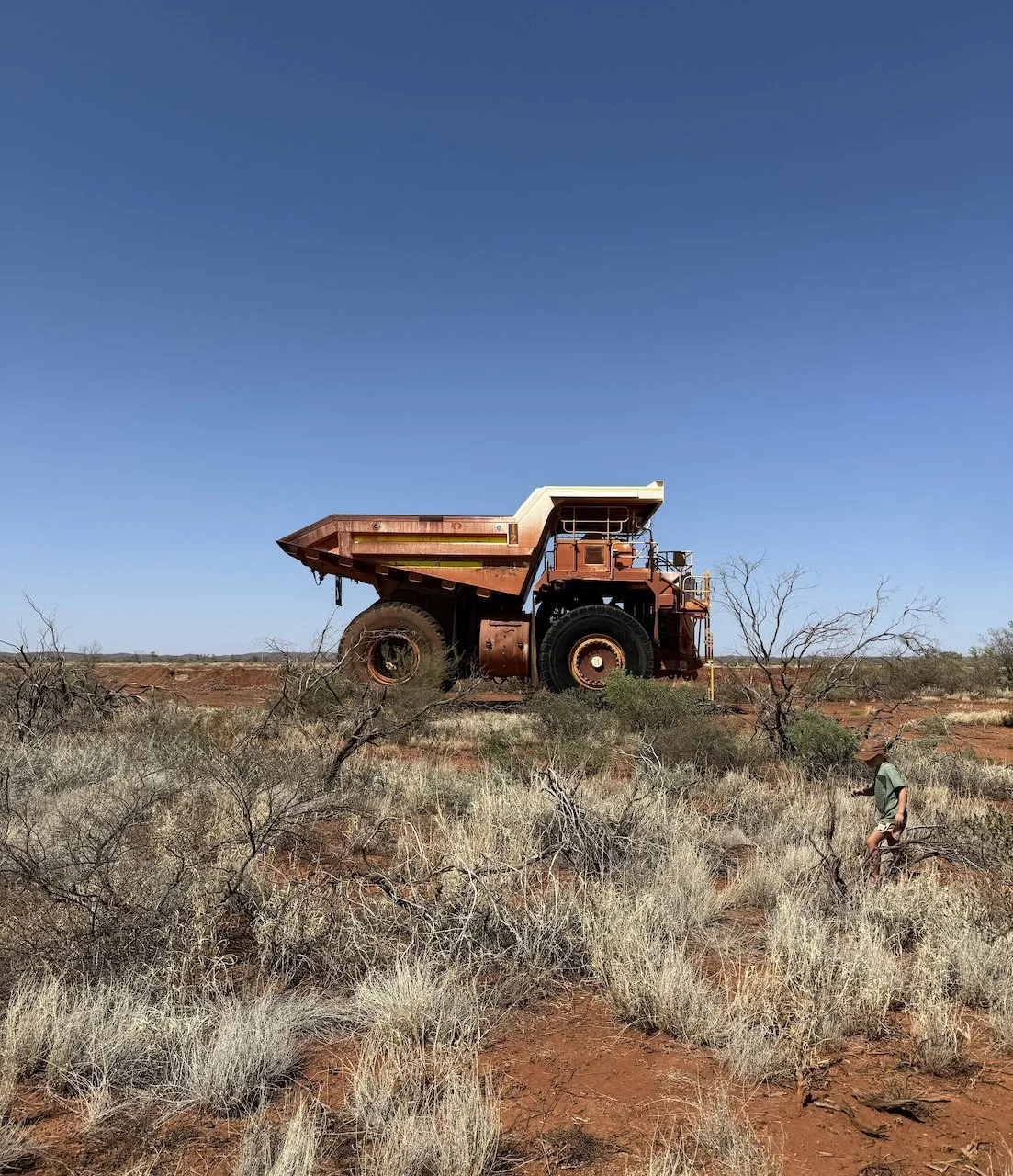
The scale of the mining in the Pilbara is astonishing, it seems like entire mountains are being disturbed. We wait at a rail crossing for about 10 minutes as a train load of iron ore not slow, but long, passes in front of us.
…
Driving south into Carnarvon for the first time brings a new perspective, for once it feels cooler here. The places I’ve visited have been tourist or mining towns, but Carnarvon is different, things grow here.
…
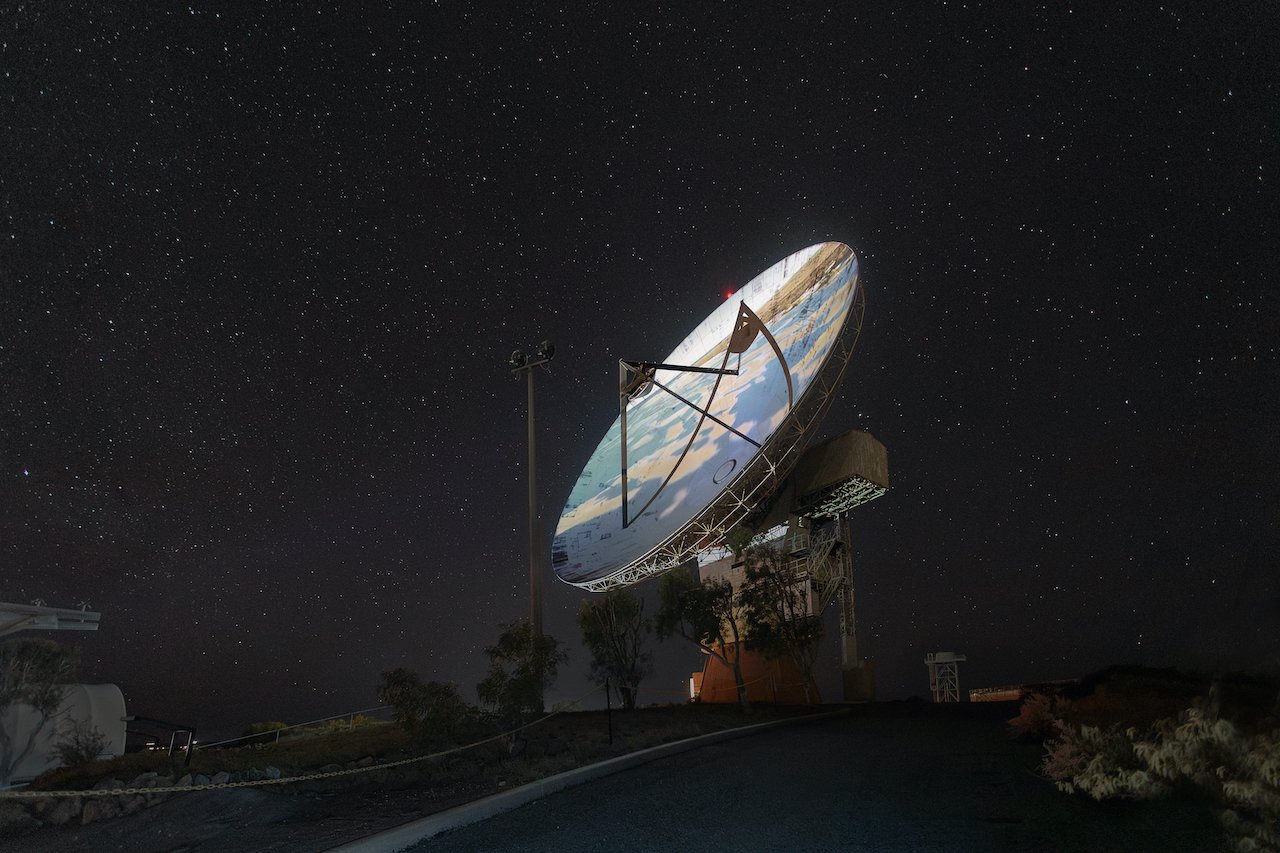
In the late afternoon, I’m racing back from Hamelin pool to meet with Phil Youd. Phil founded the Space and Technology Museum in 2012, developing it into Carnarvon’s most popular tourist attraction. Recently, he has stepped back from running the museum to focus on the refurbishment of the Dish as the Managing Director of ThothX Australia. It’s fascinating to speak with him about the repair and upgrade of the 30-meter radio antennae. Last used to track Halley’s comet in 1986, OTC, the Dish will be redeployed to track satellites in geostationary orbit. As we chat, he mentions that tomorrow he needs to set the Dish to its cyclone-season position, which will have it pointing straight up.
The projectors have already arrived, and we will pick them up after the library closes. We head up to the museum for our only opportunity to test the projection this year.
The team at the museum are gracious as we turn up at dusk, Kevin sets us up with power, and Tim comes around with a plate of garlic bread. The projection works. I send out a text to Rochelle, Keely and Stu, who leave their houses to come up and share in the excitement. Although this 'test of concept' is fleeting, we have discovered a new and spectacular space for art.
…
Producer Keely Robertson kicks off the open studio with a ‘Situational Awareness’ icebreaker, we weave in amongst each other on the lawn of the Space and Technology Museum as the sun sets, first looking down then in relation to two others until we all bunch up in the middle.
Beside a play space shuttle, looking into my phone I read a short speech about the pool, Starlink satellites, and what I’ve learned about sharing infrastructure from the bird nests on Blowholes Road.
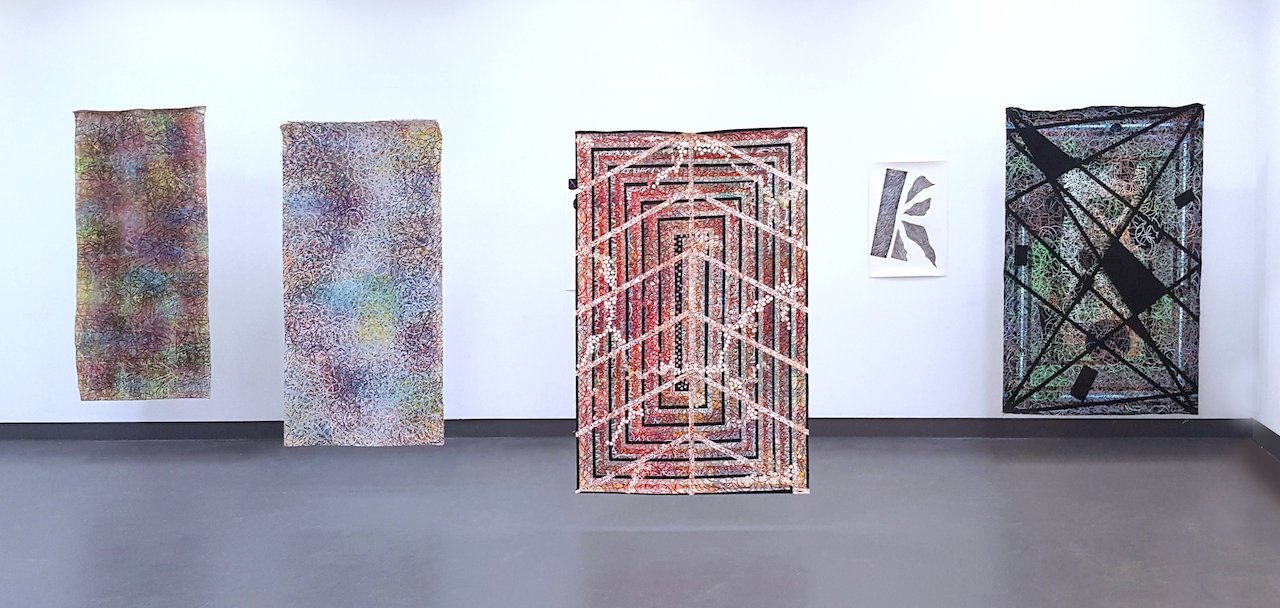
Now dark, we wander around the projections of Bush Bay and the photographs for rock making. We talk about art which encourages Kevin Williams, a First Nations artist living, working, and gardening at the Space and Technology Museum, to bring out four of his works. They’re vivid large-scale prints, at first resembling the vibrancy of geometric abstraction; however, they represent a cycle of healing from depression, anxiety, and PTSD played out through complex conceptions of time. ‘Depressional memory’ expresses the noisy multiplicity and fracturing of thoughts experienced at any one moment. Two further works, a field of circling lines and a field of angled marks both reflect the chaos of such a state of mind. ‘Life’s Journey’ follows Kevin’s life story; hard-edged dots block memories on a timeline, a lifeline that spirals outwards to the edge.
I want to capture this moment - Kevin’s artworks spread out across the ground like carpets as we talk under the festoon lights strung up on a magnificent flame tree who is as old as the dish. I missed the opportunity, luckily, Kevin allows me to include photos of the works on exhibition in this blog.
…
Images: Aerial view of OTC pool, courtesy of Carnarvon Space and Technology Museum. pool stock photography iStock:dimarik. Karijini National Park, mining truck, open studio photographs and video courtesy of Linda Tegg. Kevin Williams, chaotic thoughts, depressional thoughts, Life’s Journey, Depressional memory, layered screenprint on canvas, 2017, Installation view, QCAD Galleries. Photograph courtesy of Kevin Williams.
More information about the Circular Economies artists, host communities and projects as they unfold can be found by subscribing to SPACED’s monthly email newsletter, and following SPACED on Facebook and Instagram.
Learn more about Linda Tegg.
Circular Economies is produced as a joint partnership by PICA - Perth Institute of Contemporary Arts and SPACED.

Explore our past programs

Know Thy Neighbour #3 (2021-23). Know Thy Neighbour #3 investigates notions of place, sites of interest, networks, and social relationships with partner communities.
Whatever it is, the way you tell your story online can make all the difference.

Rural Utopias (2019-23). Rural Utopias is a program of residencies, exhibitions and professional development activities organised in partnership with 12 Western Australian rural and remote towns.
Whatever it is, the way you tell your story online can make all the difference.