
Circular Economies Residency: Sue Hauri-Downing & Tarsh Bates in Beverley #4
SPACED Circular Economies artists Susan Hauri-Downing and Tarsh Bates share reflections about their research on residency in Beverley with Beverley Station Arts.
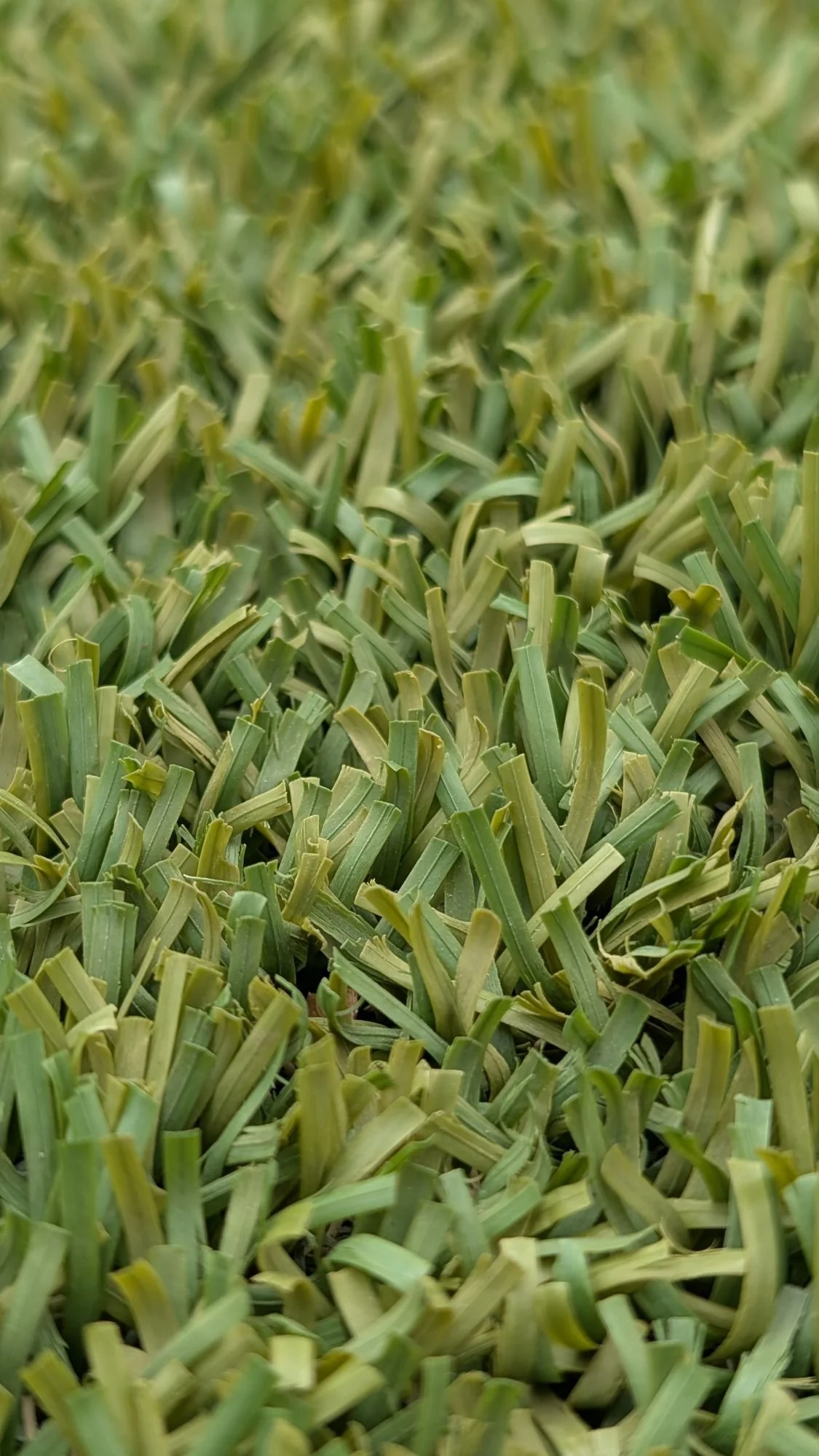
Fake lawn
In the early morning, I exercise outside the residence before the artificial turf begins to really heat up. Even now, the smell is strong as my feet shuffle across the turf and the pavement around it.
The scent takes me back to the various country towns and urban settings I’ve lived in across Australia. I’m eight years old again, jumping through the sprinkler. The plastic smell of the turf reminds me of the generations of UV-degraded hoses that lay twisted in the garden with each new rental. Throughout my childhood, I drank greedily from those hoses. I particularly remember living in Cobar, on Ngiyampaa Wangaaypuwan Country. The town’s water came through a pipeline from Nyngan, about 130 kilometres away. It was often brown, but I never really cared. My mum explained about the pipeline and reassured me that the water was safe to drink.
I remember seeing the Macquarie River, the water source, for the first time. It blew my mind that it had taken nearly three hours to drive there, and how far the water had travelled to my hose in Cobar.
I've had a steady diet of microplastics and phthalates since my childhood.
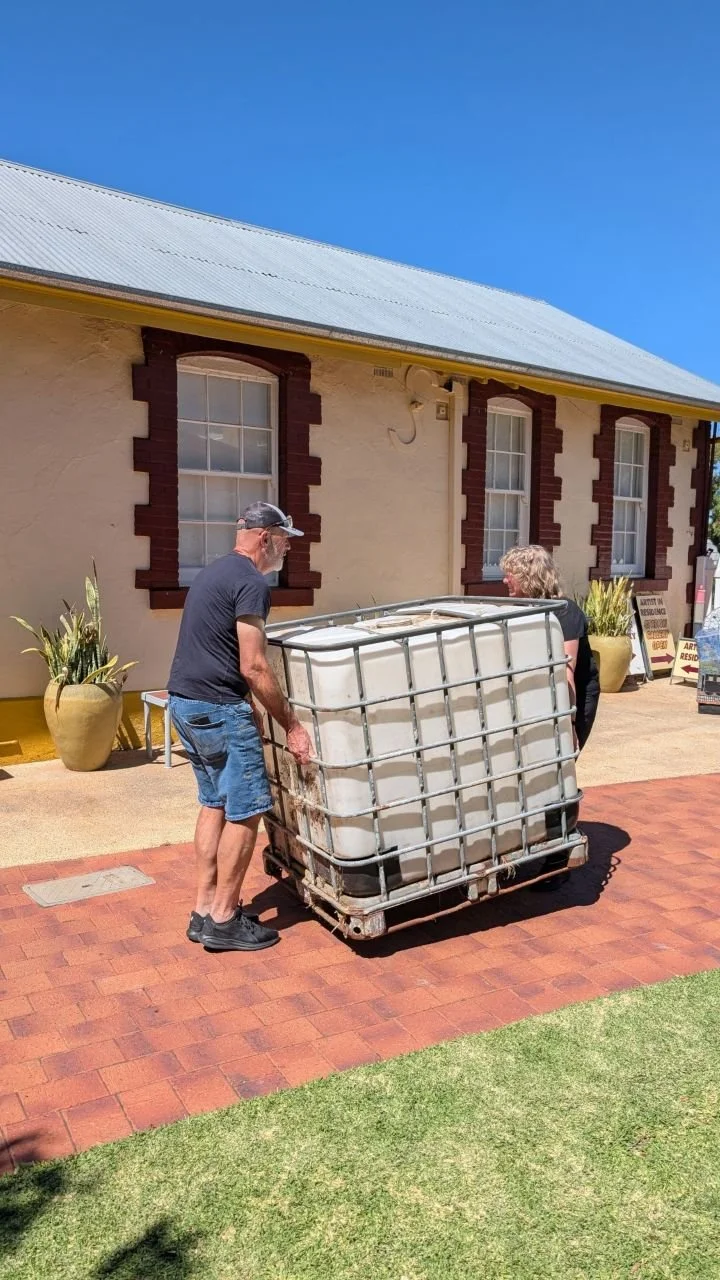
IBC (Intermediate Bulk Container)
We exchange a new IBC for Phyllis and Mike’s weathered, environmentally marked old one that they have used to collect rainwater. As soon as we get it into the gallery, I give it a good sniff-over. The moulded plastic channels have accumulated thin, dry encrustations of soil and dust that smell strongly of geosmin. The whole top of the IBC smells like it, although it's strongest in the channels where the soil lies. It’s as if the rain beat so hard into the plastic that the scent is permanently scored into it. I put my lips and nose close to the plastic and let my breath provide some moisture to facilitate my olfaction.
Geosmin is the earthy scent that rises from soil after rain. It is produced by microbes living in the soil, particularly blue-green algae and Streptomyces bacteria, and is one of the compounds that contributes to the smell we know as petrichor. The human nose is remarkably sensitive to geosmin, able to detect it at extremely low concentrations. Geosmin attracts tiny springtail insects that help spread the spores of the microbes that produce it, weaving smell into quiet soil ecological exchanges. Geosmin also permeates water systems, guiding fish migration, and causing odour and taste problems in human drinking water.
I find myself seeking out the scent because it's comforting.
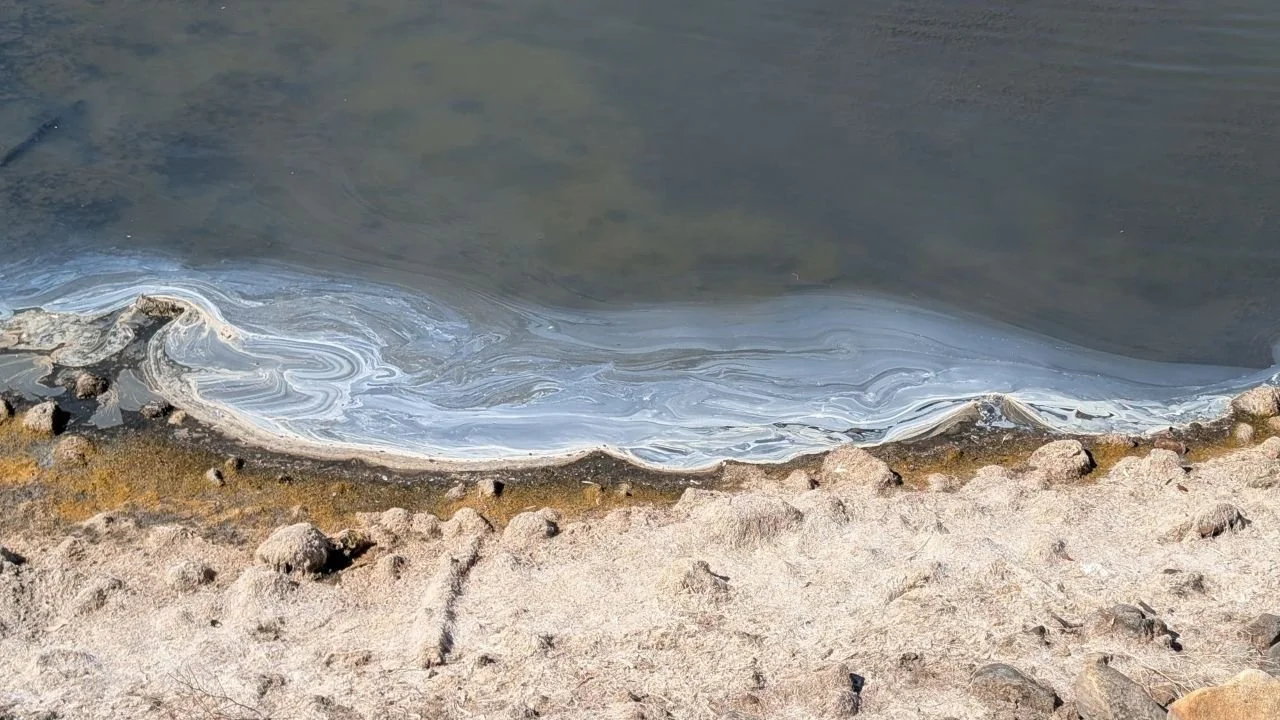
Algae
The river level has dropped significantly since we were here in Kambarang/ November last year, no longer flowing under the bridge out of town. Dried algae coat the exposed rocks, a trace of the water that was there. The scent of the algae still moistened at the water’s edge hits us as we walk to the river, pungent and glorious.
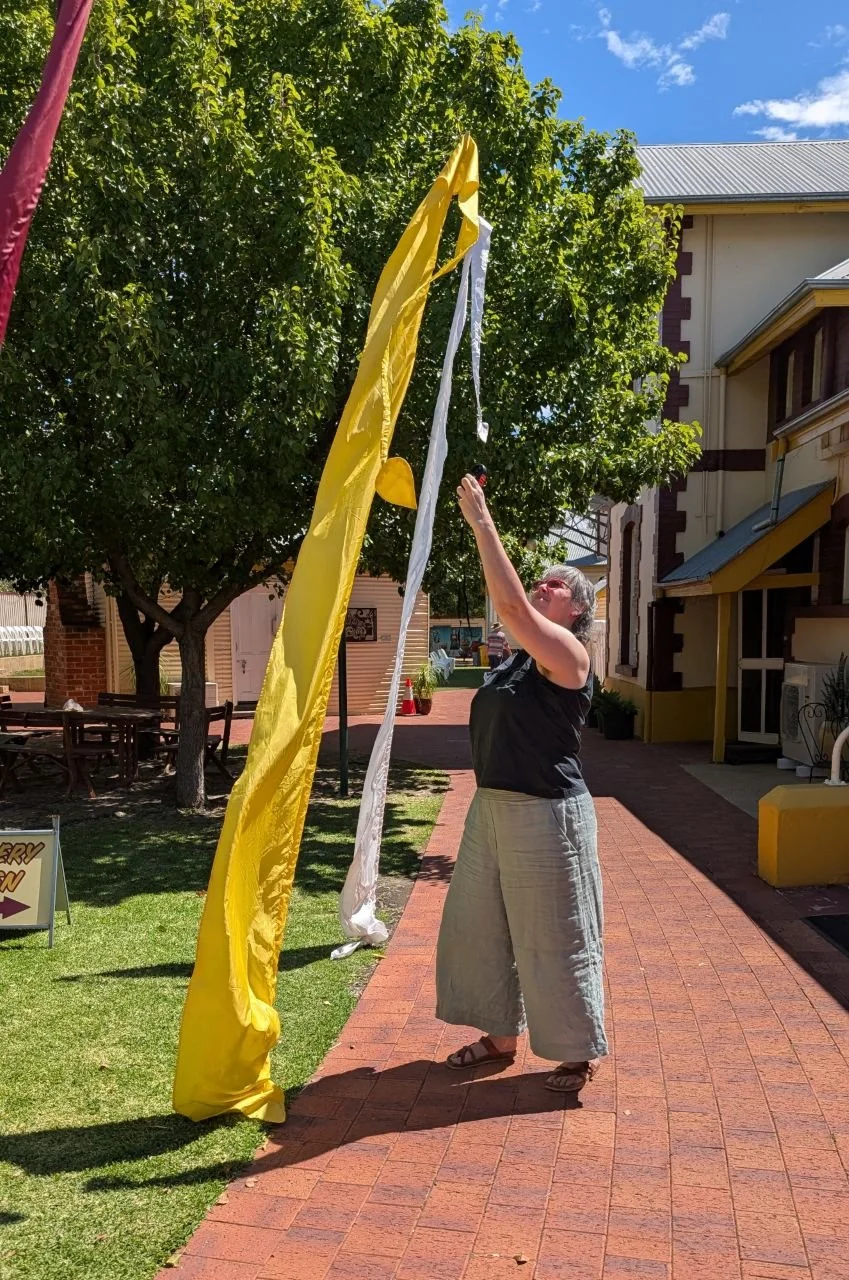
Weather
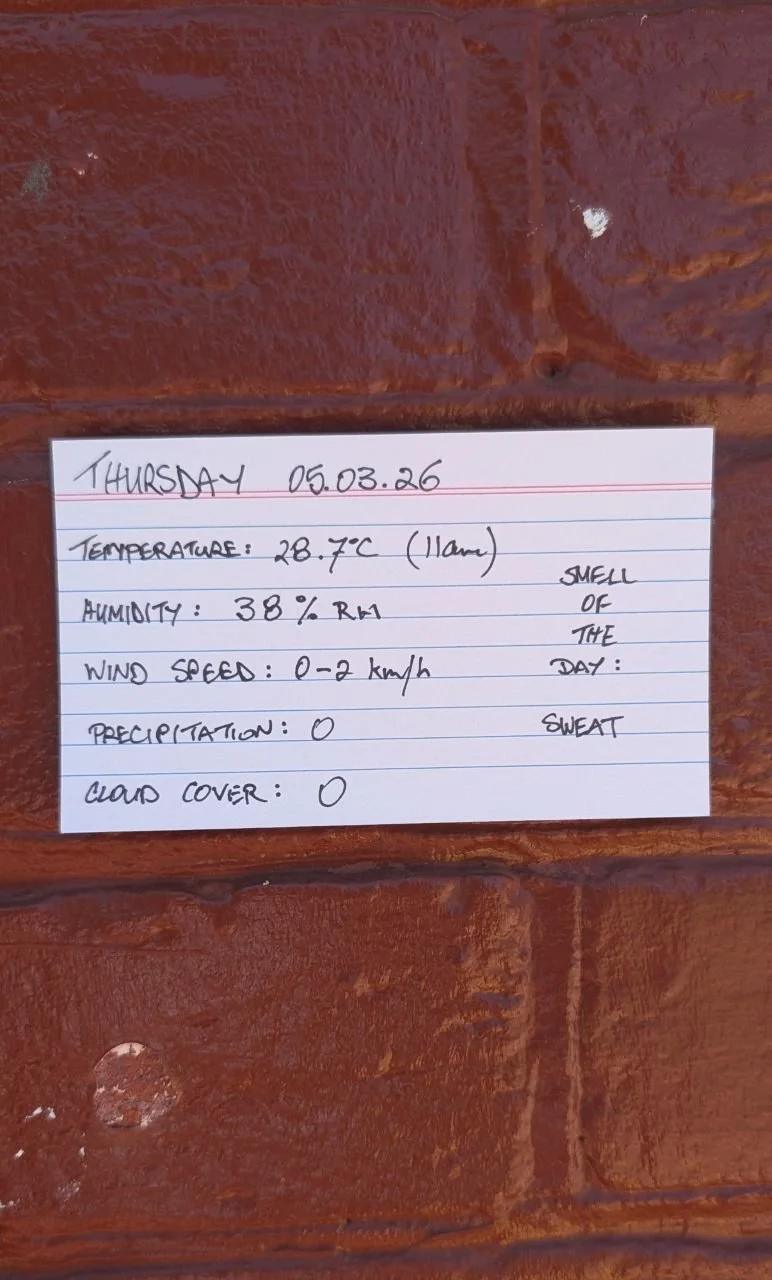
Weather conditions are vital for the production and detection of smells. Everyday, I check and record the temperature, humidity, wind speed and direction, precipitation and cloud cover, then post them outside the gallery. I also include a smell of the day.
Images courtesy of the artists, except where indicated. Fake lawn, IBC delivery, algae, weather testing, weather record.
Recording of Olfaction, Solastalgia and Art-Making: Tracing the Promise of Smellscapes in Disappearing and Emerging Ecologies Online Talk
On 17 February, PLaCE International welcomed Dr Tarsh Bates and Sue Hauri-Downing to share their work and insights during an online talk Olfaction, Solastalgia and Art-Making: Tracing the Promise of Smellscapes in Disappearing and Emerging Ecologies.
The workshop portion of this online talk encouraged participants to draw and write in response to several prompts.
If you would like to watch the discussion, the full event recording can be accessed on the PLaCE International website.
More information about the Circular Economies artists, host communities and projects as they unfold can be found by subscribing to SPACED’s monthly email newsletter, and following SPACED on Facebook and Instagram.
Circular Economies is produced as a joint partnership by PICA - Perth Institute of Contemporary Arts and SPACED.
Explore our past programs

Know Thy Neighbour #3 (2021-23). Know Thy Neighbour #3 investigates notions of place, sites of interest, networks, and social relationships with partner communities.

Rural Utopias (2019-23). Rural Utopias is a program of residencies, exhibitions and professional development activities organised in partnership with 12 Western Australian rural and remote towns.
ence.