SPACED Circular Economies artists Susan Hauri-Downing and Tarsh Bates share final reflections about their research on residency in Beverley with Beverley Station Arts.
In 2026…
Since colonisation, rainfall has declined across the WA Wheatbelt, dryness is tangible. Heat has intensified, water receded, and the smells of the living fabric of the land thinned by clearing have shifted, contracted, disappeared. The smell of petrichor is deeply welcomed.
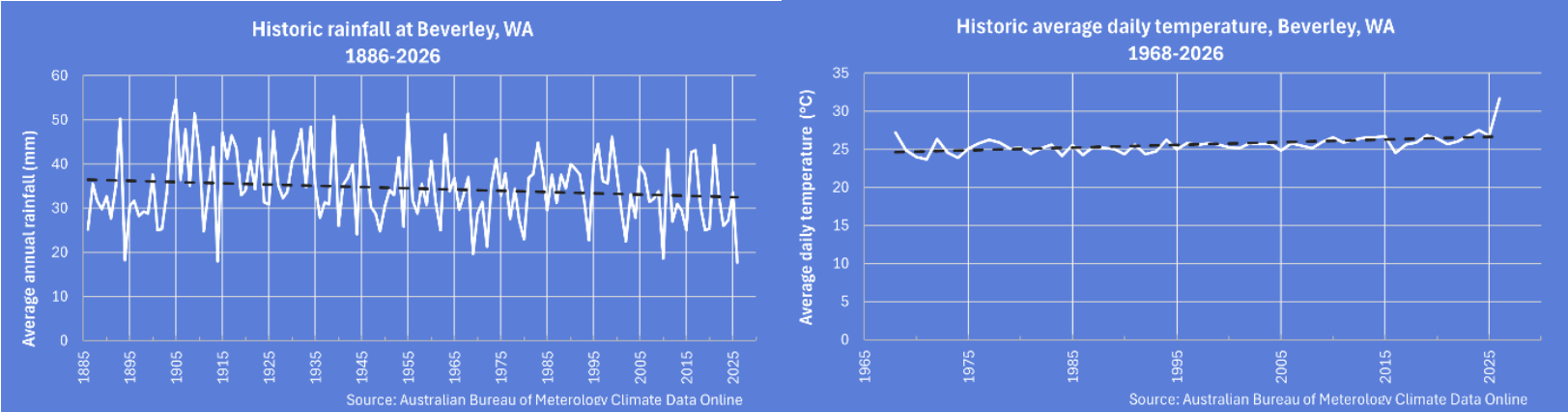
Fig 1. Beverley historic rainfall, Fig 2. Beverley historic temperature; source: Australian Bureau of Meteorology Climate Data Online.
The air carries the scents of sheep and wheat, and lupin, oats, barley and canola are also redolent. Seeding is reliant on increasingly unpredictable rainfall. Lanolin and sheep shit are becoming rarer, as sheep farming is no longer viable due to changes in the economy. People taking advantage of lower prices and proximity to Perth, bring ocean salt and petrol fumes. The fragrances of Eucalypts, balga, orchids and wildflowers persist through resilience and care.
To smell Beverley now is to whiff a living archive: the changing composition of the Avon, wheat ripening in late spring, geosmin in the wet ground after winter rain and bitumen after spring showers, Eucalyptus oil lifting in the heat, sheep lanolin, dry grass, and fungal decay after a good season, fox dens and pesticides, the anxious scarcity of diesel and fertiliser.
More than just sensory details, these are records and products of climate, biodiversity, and culture, history intertwined.
As we leave Beverly, we ask what this Wheatbelt town on Ballardong Noongar boodja / South-Western Australia, will smell like in 2050, 2070, 2090? What and whose futures do we desire?Which futures are possible?How do we maintain hope? We draw on the scents and stories we have collected, human and more-than-, climate data and projections, policies and actions to help us imagine possible future Scents of Beverley.
In 2050…
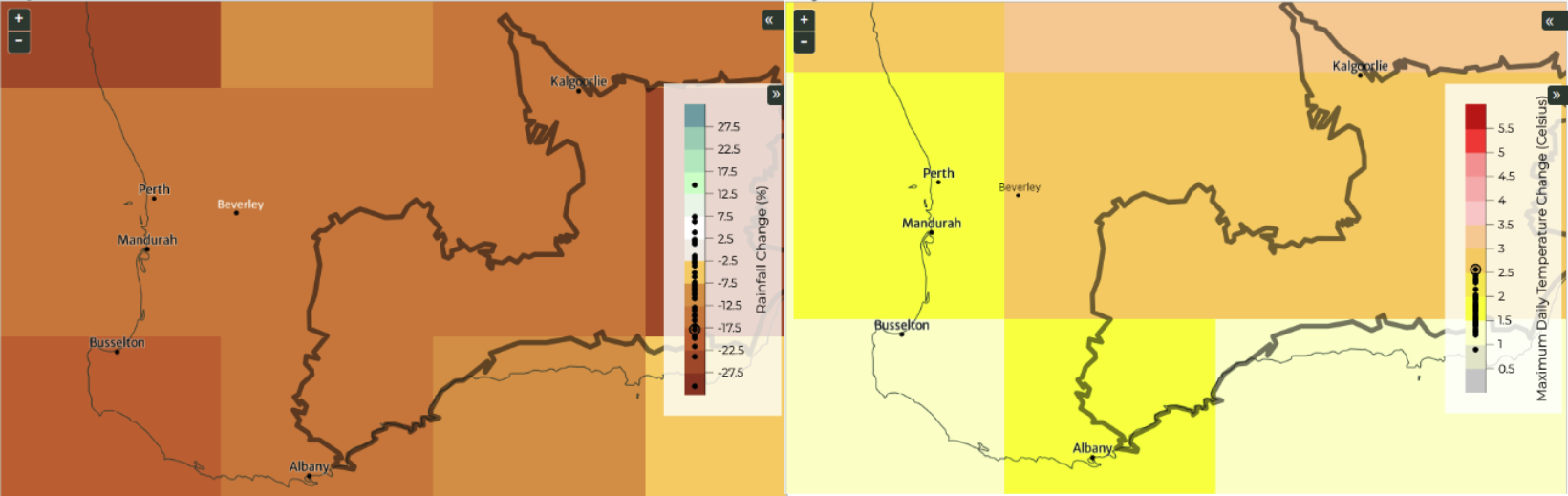
Fig 3. Beverley rain 2050. Fig 4. Beverley temp 2050. Source: https://www.climatechangeinaustralia.gov.au/en/projections-tools/map-explorer/
Autumn coolth and rains arrive later, less, more uncertain. When they come, they release a brief, electric petrichor from soils that have waited too long. The smell of petrichor that was once grounding and dependable, now feels fleeting.
Due to less rainfall, runoff, lake and river water have receded dramatically (DPIRD, 2021), mitigated by more efficient local water capture, conservation and irrigation technologies (Grower Group Alliance, 2022). The town stormwater recycling program (Government of Western Australia, 2016) has expanded to a broader wastewater program that irrigates not just the local sports fields, but town streets and gardens and the local swimming pool. Drinking water is still supplied from Perth but is mostly from desalination plants rather than Mundaring weir (Department of Water, 2021).
Crops remain, but they are drought-tolerant varieties with improved moisture retention and germination rates and shorter growing seasons, bred to withstand heat spikes that reduce yields (Grower Group Alliance, 2022).
There is more dust in the air – fine, mineral, almost metallic. The scent of decomposition is slower and drier. The absence of certain smells becomes noticeable: fewer flowering understory plants, fewer insect-rich evenings, fewer moments of decay and renewal.
Biodiversity has shifted. The scent of eucalyptus persists, albeit faint. Geraldton wax and Eremophila species common north of Perth are found here. Despite efforts by the Beverley Naturalists Club, orchids and wildflowers are increasingly rare.
The Avon River around Beverley has been revegetated by the Ballardong branch of the Wheatbelt NRM and Beverley River Care Group. Deep and freshly fragrant pools are replacing formerly stagnant and stinky algal blooms (Underwood, 2022). These pools are nurtured by the locals as infant oases in the face of the oncoming drought and heat. Insects, fish, crustaceans and rakali are starting to re-emerge. New assemblages begin to form. Old scents reappear.
In 2070…
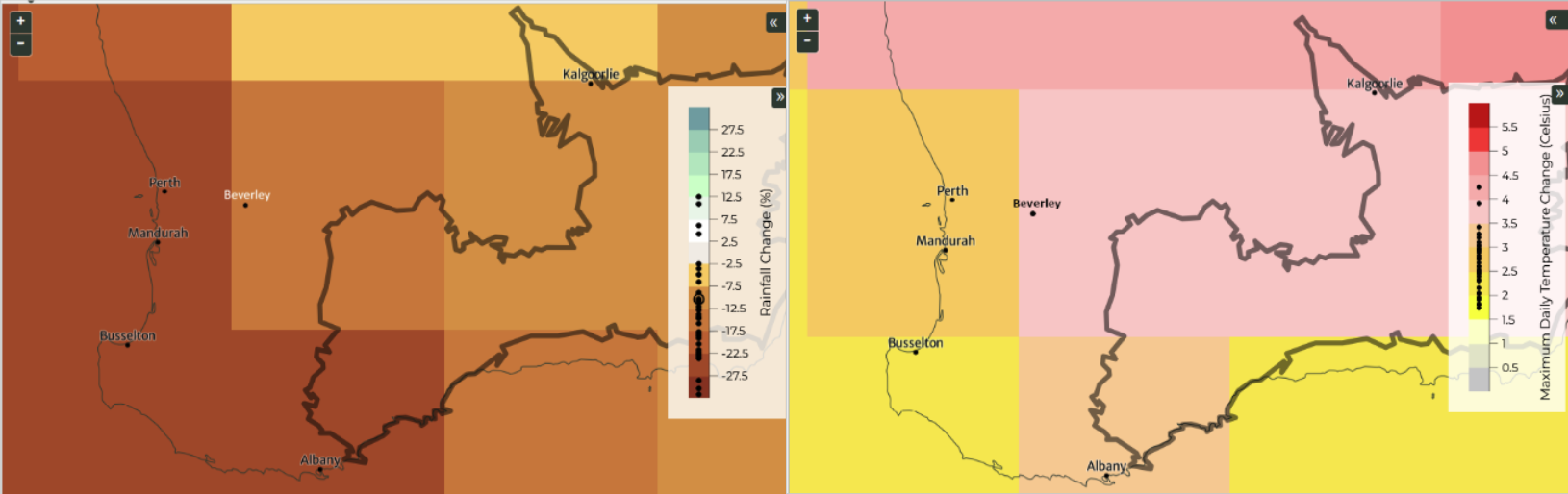
Fig 5. Beverley rain 2070. Fig 6. Beverley temp 2070. Source: https://www.climatechangeinaustralia.gov.au/en/projections-tools/map-explorer/
Winter rainfall has dropped by 10% (DPIRD, 2021). When it does arrive, it is more likely to arrive in short, intense bursts, followed by long dry periods. Petrichor smells like a hope attack. Salinity shifts as ground water responds to low rainfall and the Yenyening Lakes catchment shrinks. The scents of water are tinged with plastic, metal and faint bitter tangs of salt: IBCs, water tanks, saline traces.
Heat dominates. Crops release a baked, sweet dryness under prolonged stress. The few livestock that roam the hills carry the scent of heat, animal oils and scarcity. More frequent and intense wildfires (DPIRD, 2021) cause prevalent smells of smoke.
Broad scale agriculture adapts to increasing temperatures, lack of water, fire and food pressures from increasing populations, and the scents of machinery and synthetic inputs become more present. The smell of diesel is unusual as it becomes prohibitively expensive. Vehicles and machinery are converted to locally generated biofuels and solar electricity, trailed by the smells of French fries and ozone.
Half the farms thrive from regenerative agriculture, and the fields are redolent with geosmin, fungal traces and biological plant brews. Flowering shrubs have been planted in farms to combat salinity and improve soil quality, and the mixed fragrances of multispecies crops break up the scent of canola and oat monocultures.
Biodiversity loss and species decline has accelerated throughout the Wheatbelt, already one of the most extensively cleared regions in the world. Hardy species are more prevalent, in more simplified ecosystems, carrying the desperate smell of resilience and endurance (Kala et al, 2021).
Following the successful regeneration of Gogulgar Bilya(Avon River), the Ballardong Aboriginal NRM have taken over the management of remnant bushland and waterways. Their advice to the Shire Council on future land and water-use strategies and management is respected and acted upon (Ballardong NRM Working Group, 2006; Department of Water and Environmental Regulation, 2023). The rich smell of Boodja begins to reemerge.
In 2090…
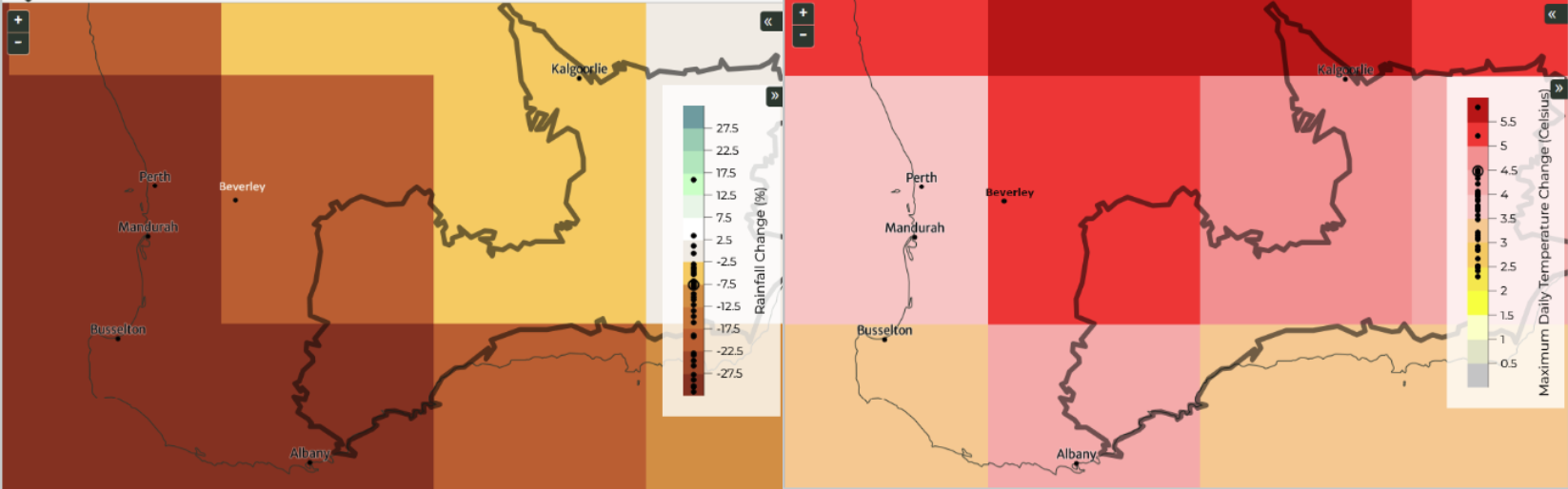
Fig 7. Beverley rain 2090. Fig 8. Beverley temp 2090. Source: https://www.climatechangeinaustralia.gov.au/en/projections-tools/map-explorer/
Beverley is unrecognisable. The Ballardong NRM have taken over, and the Shire and its inhabitants have developed an Aboriginal perspective to Boodja.
Some areas still produce food, but the systems are transformed - diversified, highly managed, or partially abandoned. Some shift toward carbon plantings, restoration zones, solar farms, or new ecological systems, attempting to stabilise what remains.
With common drought (DPIRD, 2021), the dominant smell is dryness. Not just dust, but something more pervasive: sun-warmed, parched minerals, oxidised plant matter, and traces of ash from frequent fire events. Heat itself seems to carry a scent, persistent and enveloping.
Water, when present, smells different. Wetlands and the deep pools of Gogulgar Bilya are rare and fragmented refuges. Around them, life concentrates, and so do smells - dense, biological, overripe. Where biodiversity persists, it does so in pockets. These refugia carry intense, layered scents of compressed ecosystems holding on.
A solar-powered electric train runs above the old tracks from Beverley to Perth, to York and Albany, used for important trips and transporting goods and odours throughout the region.
And there are new, unfamiliar smells... of introduced species, engineered crops, regenerative experiments and weedy blooms after rare rain.
Petrichor causes celebration.
Imagining the future Scents of Beverley is challenging and compelling. It depends on how you belong to this place, how you are oriented, what is at stake for you, and what you imagine is possible. Give it a go…
More information about the Circular Economies artists, host communities and projects as they unfold can be found by subscribing to SPACED’s monthly email newsletter, and following SPACED on Facebook and Instagram.
Circular Economies is produced as a joint partnership by PICA - Perth Institute of Contemporary Arts and SPACED
Explore our programs
Know Thy Neighbour #3 (2021-23). Know Thy Neighbour #3 investigates notions of place, sites of interest, networks, and social relationships with partner communities.

Circular Economies (2024-25) is a series of socially-engaged residencies in regional Western Australian communities, culminating in an exhibition at PICA in 2026.
ence.