
SPACED Circular Economies artists Susan Hauri-Downing and Tarsh Bates share reflections about their research on residency in Beverley with Beverley Station Arts.
Mutton
Bones surface quietly in the reserves around Beverley as if the ground is remembering.
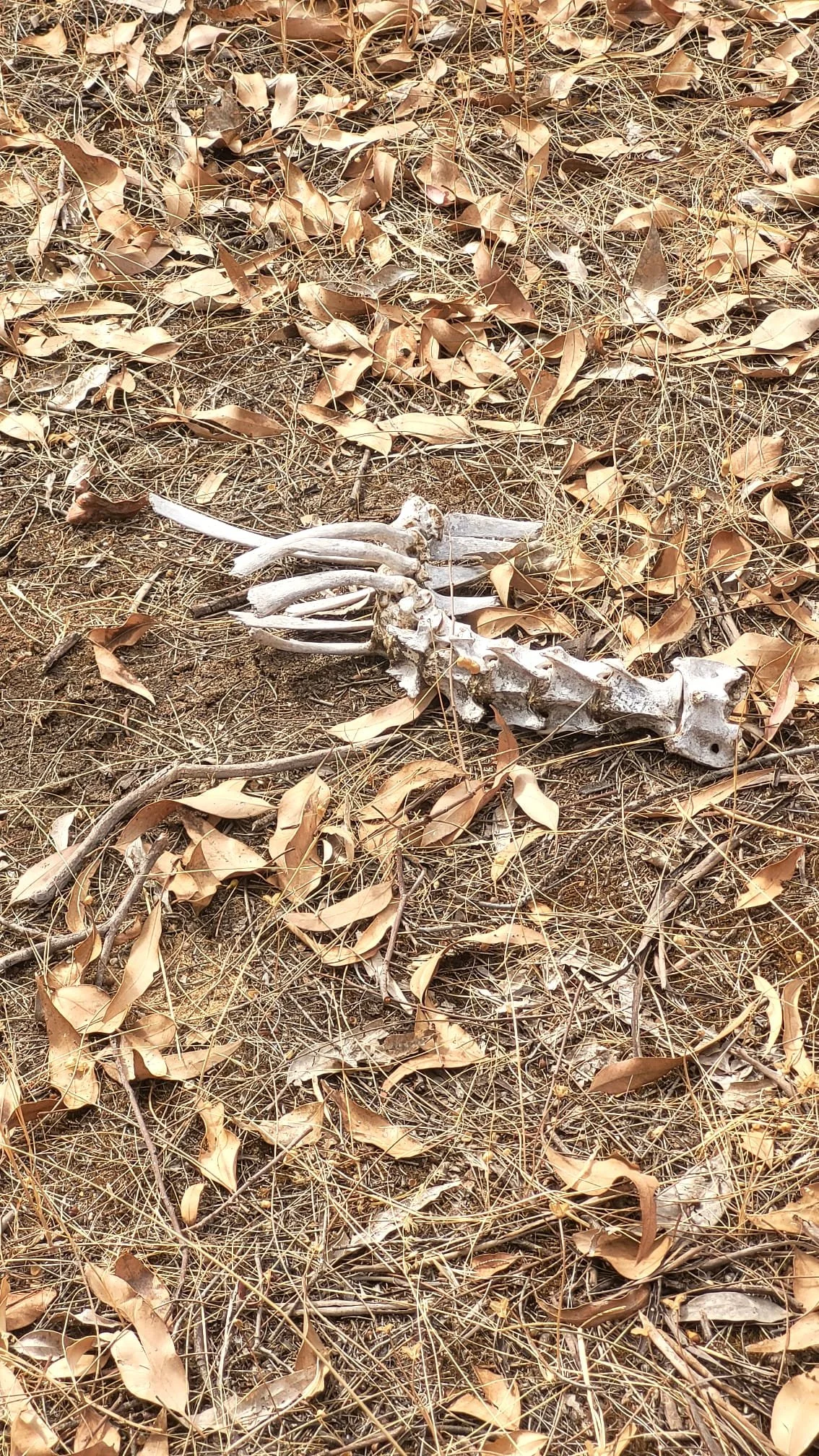
The first time I saw them, I couldn’t tell who they belonged to, sheep or kangaroos. White fragments, ribs, vertebrae, and long bones scattered and distorted through scrub, leaf litter and dust.
Steve from the Beverly Naturalist Club tells me what the land already knows: sheep carcasses have long been left here. Once, some of these reserves were dumping ground. This legacy continues.
I kneel down and bring my face close to the bone.
There it is. Unexpected, unmistakable. Mutton. A distinct, fatty trace. I am struck by its persistence. After months, maybe years, of bleaching, UV, dry wind, and heat, something of the animal still clings. Not visible, not whole, but present.
I lift a vertebra and pass it to Steve. He inhales, slowly and deliberately, his eyes narrowing briefly as if tuning himself to the faintest signal.
“Lamb stew,” he says, and opened his eyes again.
We stand there with it, the ghost of a meal, the echo of a bleat, suspended in bone.
I imagine the first days after the sheep died are different. The body is full, rupturing into the air with an immediate putridity. A smell that travels, that calls. Perhaps this is why they are dumped here, away from farms and houses, from the edges of what is kept, thrown into the reserve where foxes will find them and decomposition can unfold at a distance.
But distance is never complete. The soil holds it. The air. The bones.
Living Microorganisms
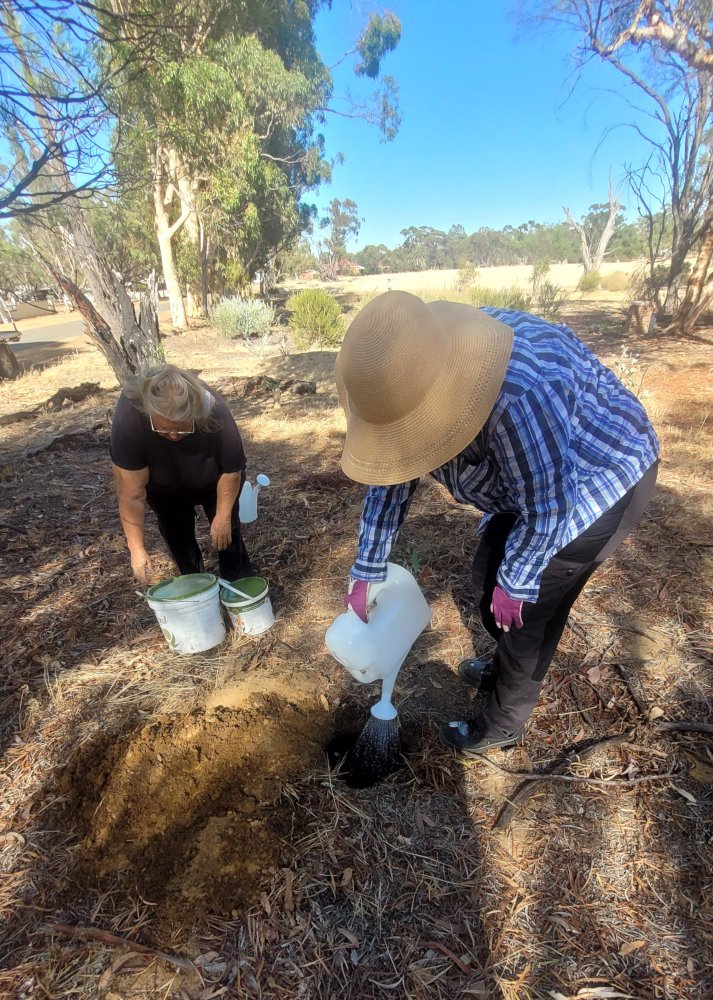
Early morning at Brooking Street, the air is fresh and the soil holds the memory of the night. With Phyllis and Steve, we plant seedlings around the Don Sacks memorial garden. A new bird bath, built since our last visit, sits surrounded by wallaby grass. Phyllis arrives with her firefighting unit, a 1000-litre IBC on the tray, and we fill watering cans as we work.
Phyllis shares her summer planting method, a recipe for keeping roots from overheating in the Beverley summer heat:
Dig a deep hole, past the neck of the shovel. If the soil is loose, a little water steadies the edges and holds the shape.
Pour in half a watering can. (The water glugs and pools, sucked into the dry ground).
Add a handful of Wettasoil.
Then another handful of native plant soil activator straight from the bucket. It carries a strong, unmistakable scent: manure-rich, organic, not unpleasant, just really nourishing shit. I read the label on the side: “This product contains a variety of naturally occurring living micro-organisms.” An unseen world in a bucket.
The rest of the water follows. A little more soil, if needed.
Then the plant goes in. We shovel soil close around it.
Another light scattering of Wettasoil.
A final, generous watering with another whole watering can.
The smell lingers on my hands, under my nails, earth, fertiliser, something fermenting, alive. It’s the scent of care and intervention, of trying to coax life through increasingly difficult conditions. Not untouched bushland, but something tended, negotiated.
Coolth
It is 45 degrees and 5% relative humidity. No clouds or wind. The sky is Beverley blue.
We walk to Brooking St Reserve. The road pulses with heat. The dirt is orange and red. The air is so dry, I can’t smell anything. There is no moisture to carry the odour chemicals through the air.
A Hitchcock of ravens gather around the guy watering his garden, panting sentinels.
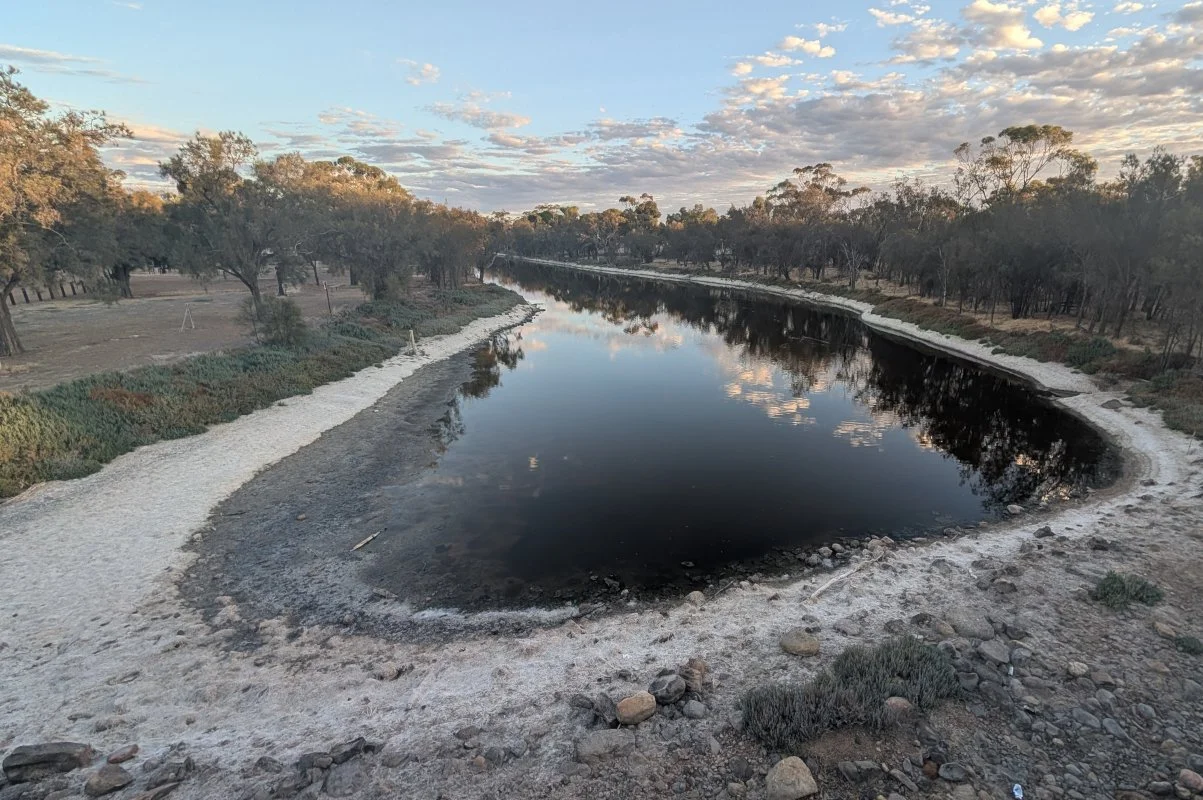
As we walk over the bridge, evaporation terraces at the edges of the river expose algae and rocks, witness to summer temperatures and terraforming decisions. The water level is noticeably lower since we arrived. It is still and dark, glistening green-brown, reflecting sheoaks and sandy river bottom.
Bec, sitting at 26 degrees in the coolth of the airconditioned gallery, laughs at us as we stagger back in, dressed in black and faces bright red. “Just testing our homeostatic systems,” we tell her. We guzzle water to assist our systems to return to normal. Smells return.
Images courtesy of the artists, except where indicated. Sheep bones, Brooking St Reserve, Beverley, living microbes, summer planting at Brooking St Reserve, Beverley, evaporation terraces, Avon River, Beverley.
More information about the Circular Economies artists, host communities and projects as they unfold can be found by subscribing to SPACED’s monthly email newsletter, and following SPACED on Facebook and Instagram.
Circular Economies is produced as a joint partnership by PICA - Perth Institute of Contemporary Arts and SPACED.
Explore our past programs

Know Thy Neighbour #3 (2021-23). Know Thy Neighbour #3 investigates notions of place, sites of interest, networks, and social relationships with partner communities.

Rural Utopias (2019-23). Rural Utopias is a program of residencies, exhibitions and professional development activities organised in partnership with 12 Western Australian rural and remote towns.
ence.